The renewal email lands on a Tuesday. A year ago your team was twelve people and the project tracker cost about $1,450 for the year. Since then you have hired six engineers, brought in two contractors for the mobile app, and given the client’s product manager a login so they would stop asking for status on WhatsApp.
The new invoice is for twenty-one seats. Finance wants to know why a tool nobody mentions in stand-up now costs more than the office internet and the accounting software together.
Nobody made a mistake. Per-seat pricing follows headcount, and a growing team rarely shrinks.
Below are the numbers for a software team in India at 10, 20 and 40 people, the places where per-seat bills grow faster than the pricing page suggests, and the cases where per-seat is still cheaper. We make Inceptimind Projects, which is sold on flat plans, so read our figures with that in mind and check the arithmetic yourself.
Where the Per-Seat Figures Come From
In November 2026 we read the published pricing of five trackers that software teams commonly use: two built for engineering teams, one board that sits on top of a code host, and two all-in-one work apps. On annual billing, the paid plan a growing team would buy cost about $5 per user per month at the cheapest. Most sat between $8 and $16, and the business tiers of the all-in-one apps ran $17 to $25. Where a tool published both prices, paying month to month added 20-35%.
The tables below use $8 as the low case and $16 as the high case, converted at ₹88 to the dollar. If the rupee has moved, swap in today’s rate; the gap between the columns will still be wide.
The Cost Table at 10, 20 and 40 People
Monthly cost, annual billing, before any card or bank charges:
| Team size | Per-seat, low ($8) | Per-seat, high ($16) | Inceptimind Projects |
|---|---|---|---|
| 10 people | ₹7,040 | ₹14,080 | ₹499 (Starter, up to 10 members) |
| 20 people | ₹14,080 | ₹28,160 | ₹999 (Team, up to 25 members) |
| 40 people | ₹28,160 | ₹56,320 | ₹2,999 (Business, no member limit) |
Across a year, the 20-person row comes to between ₹1.69 lakh and ₹3.38 lakh on per-seat pricing, against twelve months of the Team plan.
The columns don’t buy exactly the same thing. The all-in-one apps also include documents, forms, automations and work views for marketing or HR, and if your whole company would use those, part of the seat price pays for something real. A software team mostly lives in a board, a backlog, sprints, a timeline and delivery charts, so price the tools on what your team will open every day.
Flat plans have limits as well. Our Starter plan covers 5 projects and Team covers 20, so ten people running eight client projects would need Team, not Starter. Check your project count along with your headcount.
The Seats You Didn’t Plan to Buy
Budgets usually count engineers, but the invoice counts everyone who logs in.
- A four-month contractor still needs a seat, and on an annual plan you may have paid for it for all twelve months.
- Client reviewers often end up on full seats. Many tools offer guest access, but the allowance is tied to how many paid seats you hold, limited to viewing, or only on a higher tier.
- One tool we checked sells seats in steps of five once you pass five users, so your sixth person costs the same as your tenth.
- Seats removed partway through an annual term are often not refunded, and you keep paying for people who left until renewal.
- Testers, designers, the product manager and the delivery lead all move cards, and each of them needs a seat too.
On Inceptimind Projects, each plan has a fixed number of team members. When someone leaves, their place goes to the next person straight away. Access is granted per project, so a contractor sees the board they work on and nothing else.
Costs That Never Appear on a Pricing Page
Paying in dollars
Most project trackers bill in USD. On many Indian cards the foreign-currency markup is around 3.5%, with GST charged on that fee as well. Check your own card’s schedule, because banks differ. Your renewal also moves with the rupee, so a tool that cost ₹1.7 lakh this year can cost more next year at the same price in dollars.
Then there’s tax. If you are GST-registered, software services bought from abroad usually come under reverse charge. Ask your CA how that affects your input credit before the renewal, not after.
Inceptimind Projects is billed in INR every month. You pay by UPI, submit the reference in the app, and get a Bill of Supply once the payment is verified.
Moving your work in, and moving it out
Switching trackers usually costs more in time than the first year of fees. Someone exports the old data, maps one tool’s workflow onto another’s, re-creates the boards, and answers “where did my filter go?” for a fortnight. Leaving later costs the same again. Exports tend to drop comments and history, and the burndown charts you showed your client stay behind in the old tool.
Inceptimind Projects is built on GitHub, so there is nothing to import. Your projects stay in your team’s GitHub account and appear as boards, backlogs and timelines with the work already in them. Daily history snapshots are stored with your own code as a file you can open. If you stop paying, there is no export to run.
Admin time
Someone adds seats for new joiners, removes them for leavers, approves guest requests and reconciles a dollar invoice against the card statement. Expect an hour or two a month.
Is your tracker bill growing faster than your team?
Inceptimind Projects gives software teams boards, backlogs, sprints, timelines and delivery charts on flat INR plans from ₹499/mo, with no per-user charge. Tell us your team size and project count, and we'll recommend a plan and set up the workspace for you. Every plan has a 30-day money-back guarantee.
Talk to Us About Your TeamWhen a Per-Seat Tool Is the Cheaper Choice
Per-seat is the better deal in these cases:
- You are small and staying small. Several of the tools we checked have free plans for teams of up to about ten, with caps on how much work they hold, how many teams you can create or how many projects you can connect. If you fit under those caps, free is cheaper than ₹499.
- You don’t build on GitHub. Inceptimind Projects is for teams building on GitHub, and nobody else.
- Marketing, HR and sales will plan their work in the same app as engineering. An all-in-one product then spreads its seat price over more uses.
- Procurement needs specific certifications or a marketplace of integrations. Large enterprise buyers often have a checklist that only the biggest vendors meet.
- Your finance team wants card autopay. We bill monthly by UPI and verify each payment reference, which some finance teams like and others find a chore.
If one of these fits you, weigh it alongside the table.
Run the Numbers for Your Own Team
You need your last invoice, your hiring plan and about ten minutes.
- Count everyone who moves work, not just engineers: testers, designers, product and delivery leads, contractors and client reviewers.
- Add the hires planned for the next twelve months. On annual billing you will pay for them at the true-up anyway.
- Multiply by the per-user price on the billing cycle you will actually use. Monthly billing is usually 20-35% higher.
- If you pay in dollars, add your own bank’s card and currency charges.
- If you are moving tools, add the switching time: days spent, multiplied by what those days cost.
- Compare the total against a flat plan that covers your year-end headcount and your project count.
A worked example: a team of 14 today plans 6 hires, works with 3 contractors and gives 1 client a login. That makes 24 people. At the low per-seat price that is 24 × ₹704 = ₹16,896 a month, or about ₹2.03 lakh a year before card charges. The Team plan covers 25 members and 20 projects at ₹999 a month. The limits for every plan are listed on the Inceptimind Projects pricing page.
If your team sketches its sprint plan before it goes onto a board, our free online whiteboard with no sign-up works for that step and costs nothing at any team size.
Four Numbers to Track After You Choose
Check these every quarter, whichever pricing model you pick, so you know whether the tool is worth its price before the renewal date forces the question.
- Cost per active contributor: the monthly bill divided by the number of people who moved at least one card that month. On per-seat plans it creeps up as occasional viewers pile up. On a flat plan it falls as the team grows.
- Idle seats: logins with no activity in the last 30 days. If more than 10% of seats are idle, you are usually paying for leavers and one-off reviewers nobody removed.
- Time to add a person: how long it takes from “a contractor starts Monday” to “the contractor can see their board”. If that needs a purchase approval, it slows your team down.
- Planning accuracy: what a sprint planned against what it delivered. If that hasn’t improved since you started paying, how the team uses the tool matters more than its price.
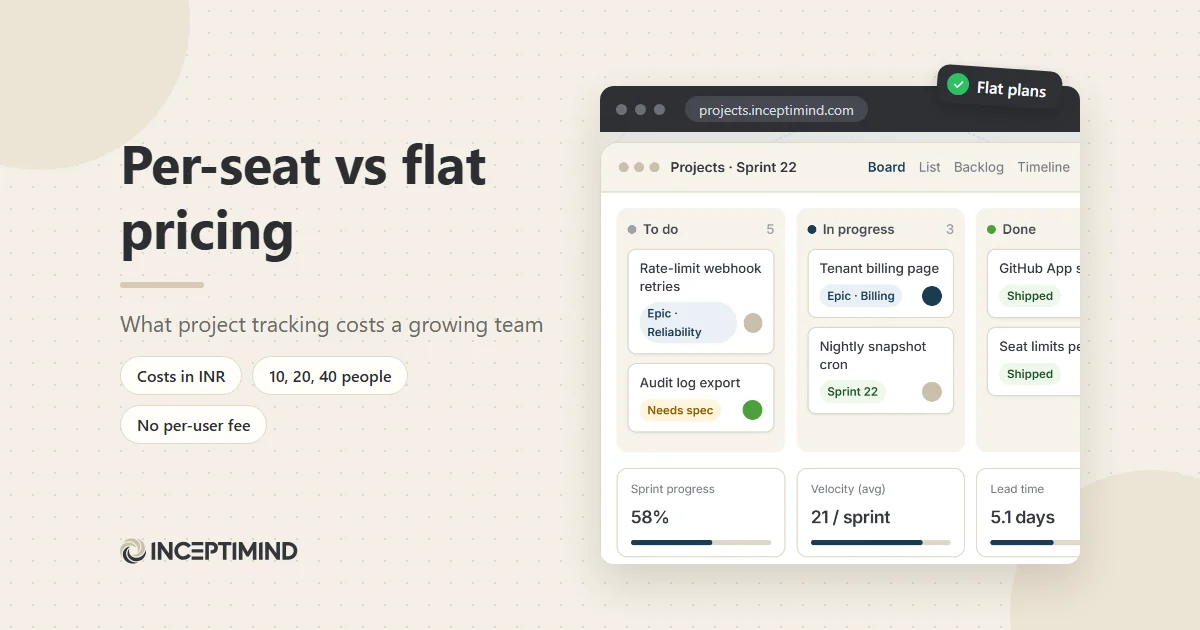
Inceptimind Projects shows velocity, burndown, lead time and cycle time from nightly snapshots, so you can read planning accuracy on the Summary view without exporting a spreadsheet.
The Decision Before Your Next Renewal
Pull last year’s invoice and count the seats that belonged to people who have since left, to contractors who stayed a few months, or to people who only opened the tool to read. If there are more than a handful, the pricing model is costing you more than the tool.
Then look at where your headcount is heading. If it is going up, get a quote on a flat plan before the renewal date, because once the renewal goes through you are paying per seat for another year.